

Table of Contents
- Do Posture Braces Actually Work?
- Posture Brace Fitting Guide: Getting the Right Fit
- Step-by-Step Application Guide for Wearing Your Brace
- How Long to Wear a Posture Corrector Daily
- Posture Corrector Exercises to Strengthen Your Back
- Common Mistakes When Wearing a Posture Brace
- Care, Maintenance, and Troubleshooting
- Building Postural Awareness Beyond the Brace
- Frequently Asked Questions
Last Updated: September 2, 2026
Do Posture Braces Actually Work?
A posture brace correctly fitted and worn with targeted exercises can help retrain muscle memory and reduce upper back tension, but it's not a standalone fix. The brace works by providing external cues that remind you to engage your scapular muscles and maintain thoracic spine alignment, but your muscles still need to do the work.
The critical misunderstanding is thinking the brace will fix posture on its own. A posture brace acts as a training tool, not a permanent solution. Research shows that people who combine brace wear with strengthening exercises see better long-term outcomes than those who use the brace alone.
Posture Brace Fitting Guide: Getting the Right Fit
A snug fit is essential, but the brace should never feel restrictive enough to cut off circulation or limit breathing. Most people either wear their brace too loose (defeating the purpose) or too tight (causing discomfort and skin irritation).
Measuring for Proper Fit
Measure around your torso at the widest point of your rib cage, just below your armpits. Wrap a soft measuring tape snugly around your back and across your chest. Most posture braces come in sizes XS through XL based on chest circumference. If you're between sizes, choose the smaller one, you can loosen the adjustment straps, but you can't make a brace larger.
When your brace arrives, try it on over a thin t-shirt. The brace should sit snugly without bunching or gaps. If you can fit more than one finger under the adjustment straps, it's too loose. If you can't fit a finger at all, it's too tight.
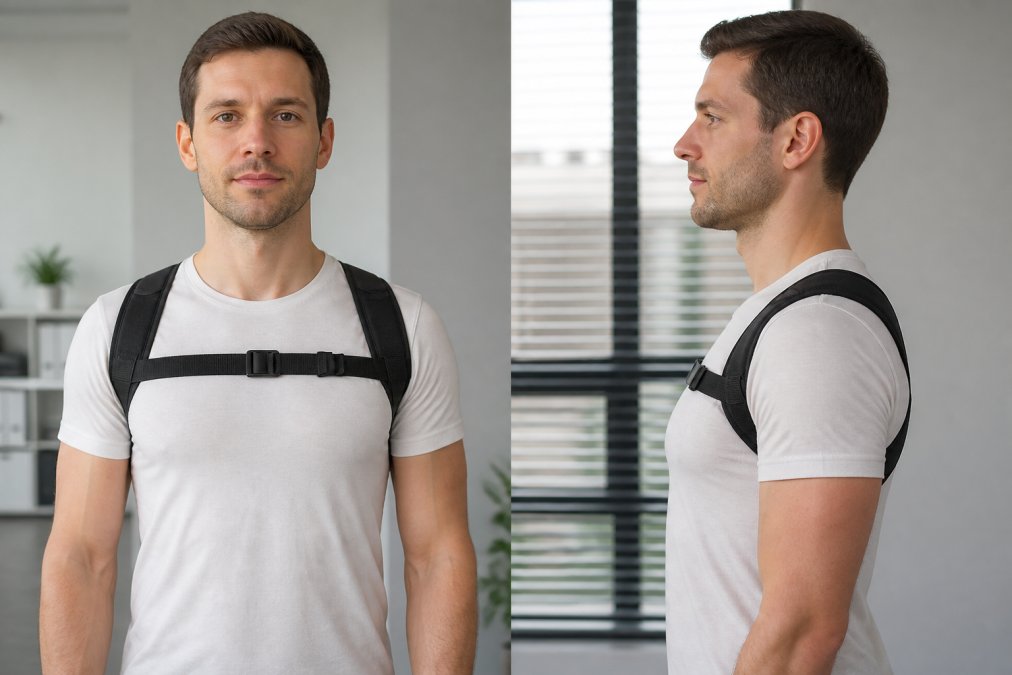
Adjustment Straps and Snug Fit
The adjustment straps control how much corrective pull the brace applies across your shoulders and upper back. Tighten them gradually, start with just enough tension to feel the brace gently pull your shoulders back, then add more tension over the next few days as your muscles adapt.
A properly adjusted brace creates a gentle corrective pull that encourages shoulder retraction without squeezing. You should breathe normally and move your arms freely. The shoulder straps should sit directly over your clavicle and scapula. Check your fit every few days during the first week, as you may need to tighten the straps slightly as your back muscles engage.
Step-by-Step Application Guide for Wearing Your Brace
Putting on your brace correctly takes less than a minute once you practice it a few times.
Before You Put It On
Wear your brace over a thin, fitted shirt or undershirt. Cotton or moisture-wicking fabrics work best, keeping sweat away from your skin and reducing friction. Make sure your brace is clean and dry before putting it on. Stand in front of a mirror so you can see what you're doing.
Proper Positioning and Fastening
Slide the brace around your torso so the main support panel sits centered on your upper back. Fasten the front closure straps, starting with the lower strap first, then work your way up. Once the front is secure, adjust the shoulder straps by pulling them back gently to create tension across your shoulders and upper back.
Tighten the straps until you feel a snug, supportive pull, not a restrictive squeeze. You should take a full breath without the brace limiting your lung capacity. Move your arms in circles and reach forward and backward to ensure normal range of motion.
How Long to Wear a Posture Corrector Daily
Start with 2-3 hours per day during your first week, wearing it during sitting or light activity, not while exercising or sleeping. Increase your wear time by 1-2 hours every 3-4 days, working up to 6-8 hours per day by the end of your second week. Most people find 6-8 hours is the sweet spot, long enough to reinforce proper alignment throughout your workday without causing muscle fatigue or skin irritation.
Do not wear your brace while sleeping. Remove it at least one hour before bed. After 4-6 weeks of consistent wear, begin reducing your daily wear time by 30 minutes every week. By week 8-10, you should be wearing the brace only 1-2 hours per day. The goal is to eventually stop wearing the brace altogether while maintaining the postural habits you've developed.
Posture Corrector Exercises to Strengthen Your Back
While your brace provides external support, your muscles maintain good posture long-term. Do these exercises 4-5 times per week, ideally while wearing your brace during the first 2-3 weeks. After 3 weeks, do the exercises without the brace to challenge your muscles to maintain alignment on their own.
Scapular Retraction and Shoulder Engagement
Sit or stand with your arms at your sides. Squeeze your shoulder blades together as if holding a pencil between them. Hold for 2 seconds, then release. Do 15 reps, rest 30 seconds, and repeat for 3 sets.
Once this feels easy, add a resistance band. Loop the band around your hands at chest height and pull toward your chest while squeezing your shoulder blades together. Do 12-15 reps. Progress to banded rows: anchor a resistance band at chest height, grab both ends, and pull your elbows back while retracting your scapula. Do 12 reps for 3 sets.

Thoracic Spine Mobility Work
Lie on your back with a foam roller positioned perpendicular to your spine at mid-back level. Support your head with your hands and gently roll backward over the foam roller, extending your thoracic spine. Roll slowly from mid-back to upper back for 2 minutes, rest, and repeat once more.
For active mobility, do thoracic rotations: sit upright with your arms crossed over your chest. Rotate your torso to the right as far as comfortable, hold for 2 seconds, then rotate left. Do 10 reps on each side for 3 sets.
Cat-cow stretches also improve thoracic mobility. Get on your hands and knees, then alternate between arching your back (cow) and rounding your spine forward (cat). Move slowly, spending 2 seconds in each position. Do 10 reps for 3 sets.
Core Strengthening for Lumbar Support
Hold a plank position for 30 seconds, rest 30 seconds, and repeat for 3 sets. As this becomes easier, increase your hold time to 45 seconds, then 60 seconds. Once you can hold a plank for 60 seconds comfortably, progress to side planks: hold for 20 seconds on each side for 3 sets.
Bird dogs strengthen deep core muscles: get on your hands and knees. Extend your right arm forward and left leg backward simultaneously, hold for 2 seconds, then return to start. Do 10 reps, then switch sides. Complete 3 sets on each side.
Dead bugs are another excellent core exercise: lie on your back with arms extended toward the ceiling and knees bent at 90 degrees. Lower your right arm overhead while straightening your left leg, then return to start. Alternate sides for 10 reps per side for 3 sets.
Common Mistakes When Wearing a Posture Brace
The most common mistake is wearing the brace too loose. A loose brace provides no corrective pull and serves only as a reminder. If you can fit more than one finger under the straps, tighten them.
Another frequent error is wearing the brace for too long without breaks. Wearing it 12+ hours per day can lead to muscle atrophy because your muscles aren't doing the work. Stick to 6-8 hours daily during the first month, then gradually reduce.
Wearing the brace without doing exercises is another trap. Your muscles won't strengthen unless you challenge them. Many people also fail to adjust the brace as their posture improves, after 2-3 weeks, you may need to loosen the straps slightly. Check your brace fit weekly and adjust as needed.
Wearing the brace while sleeping is a mistake. Remove it at least one hour before bed. Finally, some people give up too soon. Posture changes take 4-8 weeks to see significant improvements.
Care, Maintenance, and Troubleshooting
Proper care extends your brace's lifespan.
Cleaning Your Brace
Clean your brace weekly, or more often if you sweat heavily. Hand wash it in lukewarm water with mild soap. Gently scrub the straps and fabric with a soft brush to remove sweat and skin oils. Rinse thoroughly with clean water.
Never machine wash or dry clean your brace, as this can damage the support structure and adhesive. Air dry it completely before wearing it again. If the hook and loop straps lose their grip, you can purchase replaceable adhesive-backed straps separately.
Signs Your Brace Is Too Tight
Tingling or numbness in your arms or hands indicates nerve compression, loosen the straps immediately. Excessive shoulder or back pain that worsens throughout the day suggests the brace is restricting your movement. Shortness of breath or difficulty taking a full breath means the brace is restricting your rib cage. Red marks or indentations on your skin that don't fade within 30 minutes after removing the brace indicate excessive pressure.
Addressing Skin Irritation
Wear a thin, moisture-wicking shirt under the brace to reduce friction. Change into a fresh shirt if the one you're wearing becomes damp from sweat. If irritation develops, reduce your daily wear time by 1-2 hours and gradually work back up as your skin adapts. Apply a thin layer of anti-chafing balm to irritated areas before putting on the brace.
Building Postural Awareness Beyond the Brace
The ultimate goal is to develop postural awareness so strong that you maintain good alignment without the brace. Pay attention to your posture throughout the day, especially during high-stress moments when you tend to hunch forward. Set phone reminders to check your posture every hour during your workday. When the reminder goes off, pause and notice your current position, pull your shoulders back, engage your scapular muscles, and extend your thoracic spine.
At MyStuff, we understand that maintaining good posture at a desk requires both external support and ergonomic adjustments to your workspace. The Modulemaster Adjustable Laptop Stand elevates your screen to eye level, reducing the forward head posture that undermines your brace's benefits. When your screen is at the correct height, your neck stays neutral and your thoracic spine naturally extends, making it easier to maintain alignment throughout the day.

Consider your full ergonomic setup as part of your postural training. A keyboard and mouse positioned correctly, a chair that supports your lumbar curve, and a monitor at eye level all work together with your brace and exercises to reinforce good alignment.
Building lasting postural change takes commitment, but the combination of a properly fitted brace, targeted exercises, and ergonomic adjustments creates the conditions for real improvement. Start with a structured 8-week program: wear your brace 6-8 hours daily, do strengthening exercises 4-5 times per week, and gradually reduce brace dependence as your muscles strengthen. By week 8, you'll have developed the postural awareness and muscle endurance to maintain good alignment on your own. At MyStuff, we're committed to supporting your journey toward better posture and workspace wellness. Explore our ergonomic solutions, including the Modulemaster Adjustable Laptop Stand, and discover how the right tools can eliminate neck strain and boost your productivity. Shop Smart Essentials today and experience the difference proper ergonomics makes.
Frequently Asked Questions
How many hours a day should I wear a posture brace?
Most users benefit from wearing a posture corrector for 2-4 hours daily during activities that trigger poor alignment, such as desk work. Start with shorter sessions (30-45 minutes) and gradually increase duration as your muscles adapt. Wearing it too long can create dependency and reduce natural muscle engagement. Consistency matters more than duration, daily wear during specific activities is more effective than sporadic all-day use.
Do posture correcting braces actually work?
Posture braces provide immediate biofeedback and clavicle support, helping you maintain proper shoulder retraction and thoracic spine alignment. However, they work best as part of a complete approach that includes strengthening exercises and postural awareness. The brace itself does not permanently fix posture, it trains your body to recognize correct alignment. Combined with targeted exercises and habit formation, most users report reduced upper back tension and improved alignment within 4-6 weeks.
Should a posture brace be tight or loose?
A posture brace should be snug but not restrictive. You should be able to fit one finger under the adjustment straps comfortably. If the brace causes tingling sensations, numbness, or restricts your range of motion, it's too tight and may compress nerves or limit muscle engagement. A proper fit provides corrective pull without reducing circulation or causing skin irritation. Adjust tension regularly as your muscles strengthen and your awareness improves.
Can you wear a posture brace under your clothes?
Yes, most posture braces can be worn discreetly under clothing, making them suitable for office and professional settings. Wear it over a thin, moisture-wicking base layer to reduce skin irritation and allow sweat to evaporate. Avoid wearing it directly against bare skin for extended periods. Check your brace's hook and loop closure design, some models are bulkier than others. For all-day wear, choose a slim-profile brace designed for clothing compatibility.
This article was written using GrandRanker