

Table of Contents
- Why Ergonomic Setup Matters in Compact Workspaces
- Monitor Height and Eye Level Positioning
- Chair Adjustment and Lumbar Support Essentials
- How to Fix Neck Pain from Desk Work
- Keyboard and Mouse Placement for Neutral Posture
- Ergonomic Desk Accessories for Small Spaces
- Best Compact Standing Desks for Limited Square Footage
- Lighting, Movement, and Workspace Optimization
Last Updated: August 25, 2026
Why Ergonomic Setup Matters in Compact Workspaces
A best ergonomic desk setup for small offices isn't a luxury, it's the foundation of productivity and long-term health. Small offices amplify ergonomic mistakes because there's no room to adjust. Every placement decision becomes permanent until you redesign the entire setup. Poor positioning compounds faster than in larger spaces, leading to neck strain, lower back pain, and repetitive strain injuries.
According to OSHA ergonomics guidelines, improper workstation setup is one of the leading preventable causes of workplace injury. For remote workers and small office professionals, there's no ergonomics officer checking your setup.
This guide covers the exact strategies to build a best ergonomic desk setup for small offices that protects your spine, reduces eye strain, and actually fits in the space you have.
Monitor Height and Eye Level Positioning
Your monitor height determines whether you spend eight hours looking slightly down (neutral), significantly down (neck strain), or up (cervical spine compression). The ideal position places the top of your screen at or slightly below eye level when seated in neutral posture (peer-reviewed research).
In small offices, most people fail by stacking the monitor on books or cheap risers that put it too high or too low. When your eyes look down 15 degrees or more, your neck tilts forward to compensate (peer-reviewed research). Hold that position for six hours and you understand why "tech neck" is a real diagnosis.
For compact spaces, a monitor arm solves this elegantly. Instead of consuming desk real estate with a stand, an arm mounts to the desk edge and swings into position, freeing up workspace. The arm adjusts vertically so you can dial in your exact eye level and horizontally so you can position the screen at arm's length, roughly 20 to 26 inches from your eyes.
If you use a laptop, prop it on a stand and use an external keyboard and mouse. A simple adjustable laptop stand lifts the screen to eye level while keeping the keyboard accessible below. This setup takes minimal space and costs far less than a monitor arm.

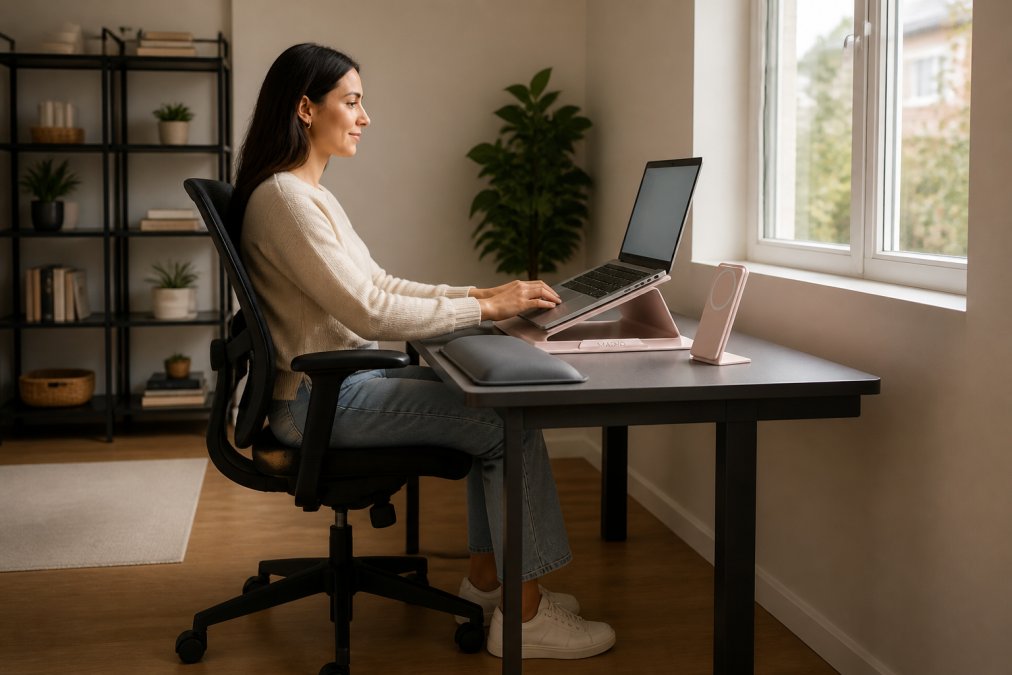
Test this by sitting in your normal working position: your eyes should naturally look at the upper third of the screen without tilting your head.
Chair Adjustment and Lumbar Support Essentials
Your chair is the second-most important piece of equipment after monitor placement. A bad chair makes good posture impossible.
Lumbar support is critical. Your lower back has a natural inward curve (lordosis). When you sit without support, that curve flattens and your discs compress unevenly. A chair with proper lumbar support maintains that curve, distributing pressure evenly across your vertebrae.
In small offices, prioritize adjustability over size. A smaller chair with height adjustment, seat depth adjustment, and lumbar support outperforms a larger chair without these features.
Here's what to adjust:
- Seat height: Your feet should rest flat on the floor with your knees at roughly 90 degrees.
- Seat depth: Sit with your back against the backrest and have about two to three finger widths of space between the front of the seat and the back of your knees.
- Lumbar support height: Adjust it so the curve supports your lower back at the point where your spine naturally curves inward, usually around waist level.
- Backrest recline: A slight recline (around 100 to 110 degrees) is more comfortable than sitting fully upright for extended periods.
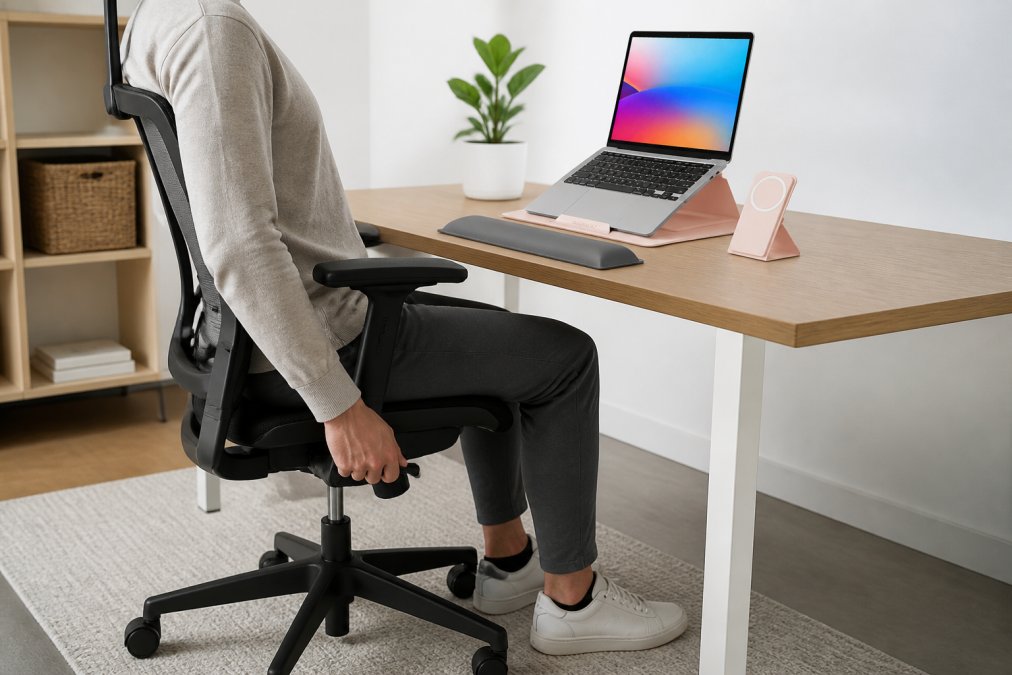
For small spaces, consider a chair with armrests that adjust in height and width. Armrests reduce the load on your shoulders and neck by supporting your forearms.
How to Fix Neck Pain from Desk Work
Neck pain from desk work is almost always caused by monitor height, forward head posture, or static positioning without breaks. All three are fixable.
Start with monitor height. If your monitor is too low, your neck flexes forward. Move your monitor up. This single change resolves neck pain for many people within days.
Next, check your posture. Forward head posture, where your head juts forward of your shoulders, happens when you lean toward your screen or when your keyboard forces you to hunch. Fix it by moving your monitor closer and ensuring your keyboard is at elbow height so your shoulders relax.
The third factor is static positioning. Your neck muscles need movement. Take a two-minute break every hour. Stand up, look away from the screen, and move your neck gently through its range of motion.
If you've adjusted your monitor height and posture and still experience neck pain, your chair may be the issue. A chair that doesn't support your upper back forces your neck to compensate. A chair with a tall backrest that supports your thoracic spine (mid-back) takes the load off your neck.
Movement is the ultimate fix. Sedentary behavior causes musculoskeletal problems. Even five minutes per hour of standing, stretching, or walking makes a measurable difference.
Keyboard and Mouse Placement for Neutral Posture
Your keyboard and mouse position determines whether your wrists, forearms, and shoulders are in neutral or stressed positions. Neutral means your wrists are straight, your elbows are close to your body, and your shoulders are relaxed.
The keyboard should sit at elbow height when your arms hang naturally at your sides. If the keyboard is too high, your wrists bend upward (extension), compressing the tendons and nerves in your carpal tunnel. If it's too low, your wrists bend downward (flexion), which also compresses those structures.
In small offices, keyboard placement is often compromised by desk height. The ideal solution is an adjustable desk. If you can't adjust your desk height, use a keyboard tray. A keyboard tray mounts under your desk and adjusts independently of the desktop, solving the height problem without consuming desk real estate.
Your mouse should sit at the same height as your keyboard, immediately adjacent to it. Your arm should be relaxed at your side with your elbow bent at roughly 90 degrees.
For small spaces, an ergonomic mouse designed to fit the contour of your hand reduces pressure on your palm. The MyStuff Wireless RGB Gaming Mouse features an ergonomic honeycomb design that fits naturally in your hand, reducing palm pressure during long work sessions. At $13.13, it's an affordable way to improve wrist positioning without consuming extra desk space.

Ergonomic Desk Accessories for Small Spaces
Small offices require accessories that solve space constraints while improving ergonomics.
Adjustable Laptop Stands and Monitor Arms
An adjustable laptop stand elevates your screen to eye level while keeping your keyboard and trackpad accessible. The MyStuff Modulemaster Adjustable Laptop Stand provides customizable height positioning at $48.66, reducing strain on your neck and eyes during long work sessions.
For dual-monitor setups or when you need flexibility, a monitor arm is worth the investment. A single monitor arm mounts to the desk edge and swings into position, freeing up the desk surface that a traditional stand would consume. You can position your screen at the exact height and distance you need, then adjust it throughout the day as your tasks change.
Vertical Storage and Cable Management Solutions
Small offices are cluttered offices. Vertical storage solves this by moving items off your desk and onto the walls.
Wall-mounted shelves above your desk provide storage without consuming floor or desk space. Keep your desk surface clear for active work. Cable management is essential: cables should not cross your desk or dangle behind it. Use cable trays mounted under your desk to route cables neatly and velcro cable ties to bundle them together.
Your desk feels larger because it's uncluttered, and your focus improves because you're not visually distracted by mess. The MyStuff 5-in-1 Wireless Charging Station ($41.73) eliminates cable clutter by charging your iPhone, Apple Watch, and AirPods simultaneously on a single compact base with an integrated ambient light, freeing up desk space and reducing cables.

Best Compact Standing Desks for Limited Square Footage
Standing desks reduce sedentary behavior and improve circulation. The problem is that most standing desks are large and expensive. In a small office, a full-size standing desk can dominate the room.
A desk converter sits on top of your existing desk and raises up to standing height when needed. It costs a fraction of a full standing desk and requires no installation. When you're done standing, you lower it back down. This flexibility is perfect for small offices.
A compact standing desk is smaller than a traditional desk but still provides enough surface for a monitor, keyboard, and mouse. Some fold up when not in use, which saves space if you hot-desk or share your office.
Dynamic seating, alternating between sitting and standing, is more important than standing all day. Standing for eight hours straight is as problematic as sitting for eight hours. The goal is movement and position changes.
Lighting, Movement, and Workspace Optimization
Lighting and movement are the final pieces of the ergonomic puzzle. Poor lighting causes eye strain, which leads to forward head posture, which causes neck pain. Lack of movement causes musculoskeletal stiffness and fatigue.
Task lighting is essential. Your overhead lighting should be supplemented with a desk lamp that illuminates your work surface without creating glare on your monitor. Position the lamp to the side of your screen so light doesn't reflect off the display.
Glare reduction is critical. If your monitor reflects your face or the window behind you, you're straining your eyes. Reduce glare by positioning your monitor perpendicular to windows or adjusting your screen brightness to match your ambient lighting.
Micro-breaks are non-negotiable. Every 30 to 60 minutes, look away from your screen for at least 20 seconds and focus on something at least 20 feet away. This simple practice (the 20-20-20 rule) prevents digital eye strain and the forward head posture that follows.
Movement breaks are equally important. Every hour, stand up and move for at least two minutes. This interrupts static positioning and activates muscles that have been idle, preventing stiffness and improving circulation.
Posture alignment throughout the day is the real challenge. Check your posture every 15 minutes during your first week. Your shoulders should be relaxed, your back against the chair, your feet flat, and your eyes looking at the upper third of your screen. This becomes automatic after a few weeks.
| Ergonomic Element | Small Space Solution | Key Benefit |
|---|---|---|
| Monitor Height | Adjustable stand or monitor arm | Prevents neck strain and forward head posture |
| Chair Support | Adjustable chair with lumbar support | Reduces lower back pain and disc compression |
| Keyboard Position | Keyboard tray or adjustable desk | Maintains neutral wrist position |
| Mouse Placement | Ergonomic mouse at elbow height | Reduces shoulder and wrist strain |
| Cable Management | Under-desk trays and velcro ties | Frees desk space and improves aesthetics |
| Vertical Storage | Wall-mounted shelves | Eliminates desk clutter and improves focus |
| Standing Option | Compact standing desk or converter | Reduces sedentary behavior |
| Lighting | Task lamp with glare reduction | Prevents eye strain and forward head posture |
| Movement | Hourly breaks with stretching | Prevents musculoskeletal stiffness |
A best ergonomic desk setup for small offices doesn't require a large space or a large budget. It requires intentional positioning of your monitor, chair, keyboard, and mouse, combined with accessories that solve space constraints. MyStuff's Modulemaster Adjustable Laptop Stand ($48.66) and Wireless RGB Gaming Mouse ($13.13) provide the core tools you need to optimize a compact workspace without breaking the bank. Start with monitor height and chair adjustment, these two changes alone resolve pain for most people. Add the accessories that fit your space constraints and take movement breaks every hour. Your spine will thank you, and your productivity will follow.
Frequently Asked Questions
Q: How do you set up an ergonomic workstation in a small space?
A: Start with chair height: your elbows should bend at 90 degrees when your arms rest at your sides. Position your monitor or laptop at eye level using an adjustable stand like the Modulemaster Laptop Stand ($48.66) to reduce neck strain. Keep your keyboard and mouse at elbow height on a compact desk, ensuring your wrists stay in neutral posture. Use vertical storage for cables and supplies to maximize floor space. A footrest helps maintain proper leg positioning when desk height can't be adjusted. These steps create neutral posture without requiring extra square footage.
Q: What is the best way to fix neck pain from desk work?
A: Neck pain typically stems from poor monitor placement or slouching. Position your screen so the top of it aligns with your eye level when you sit upright, this prevents forward head posture, the leading cause of cervical spine strain. Use an adjustable laptop stand to achieve this height. Take micro-breaks every 20-30 minutes to stretch your neck and shoulders. If pain persists, a monitor arm or ergonomic desk accessories can help maintain proper alignment throughout the day.
Q: What are the essential components of an ergonomic desk setup?
A: The core components are: a chair with lumbar support and adjustable height, a desk at elbow height (typically 28-30 inches), a monitor at eye level, a keyboard and mouse at elbow height, and proper foot support. In small spaces, add a monitor arm or adjustable laptop stand to save desk real estate while maintaining eye-level positioning. Include task lighting to reduce glare and eye strain. A footrest ensures proper leg positioning when your desk height is fixed. These elements work together to support neutral posture and reduce repetitive strain injury risk.
Q: Why is monitor placement so critical for ergonomic health?
A: Your monitor position directly affects your cervical spine and shoulder alignment. When the screen is too low, you lean forward, creating forward head posture, this increases load on your neck by up to 60 pounds at a 45-degree angle. When it's too high, you strain your upper trapezius muscles. The ideal position places the top of your monitor at or slightly below eye level, about 20-26 inches from your eyes. This maintains neutral cervical spine alignment and reduces musculoskeletal strain. In small offices, an adjustable stand or monitor arm achieves this without consuming desk space.
Q: How can I maximize vertical space in a small office for ergonomic accessories?
A: Use wall-mounted shelving above or beside your desk for storage, keeping frequently used items within arm's reach but off the desktop. Install a monitor arm or adjustable stand to free up desk surface for keyboard, mouse, and work materials. Use cable management clips or vertical organizers to route cords along walls or desk edges. A pegboard or wall-mounted organizer holds small accessories like a wireless mouse ($13.13) or keyboard shortcuts sticker ($7.67). Drawer dividers and under-desk storage containers keep supplies organized vertically. This approach maintains proper ergonomic positioning while reclaiming valuable small-office floor space.
This article was written using GrandRanker