

Table of Contents
- What Affects Portable Vacuum Battery Performance
- Understanding Handheld Vacuum Runtime Expectations
- TSA Regulations for Lithium-ion Batteries in Portable Vacuums
- How to Extend Vacuum Battery Life During Travel
- Portable Vacuum Battery Life for Travel: Real-world Use Cases
- Charging Time and Convenience for Frequent Travelers
- Battery Degradation Over Time and What to Expect
- Conclusion
Last Updated: August 26, 2026
What Affects Portable Vacuum Battery Performance
Battery performance in handheld vacuums depends on several interconnected factors. The motor's power consumption is primary: stronger suction requires more energy, draining the battery faster. Dust capacity also matters; as the collection bin fills, airflow becomes restricted, forcing the motor to work harder and consume additional power.
Lithium-ion batteries dominate the portable vacuum market, delivering consistent power until nearly depleted, then dropping off sharply. Temperature affects performance too, a vacuum rated for 60 minutes at room temperature might deliver only 40 minutes in cold environments. Battery age, humidity, and frequent turbo mode use all compress real-world runtime below manufacturer claims.
Understanding Handheld Vacuum Runtime Expectations
Handheld vacuum runtime typically ranges from 20 to 60 minutes depending on the model and operating conditions. These figures assume continuous use at standard suction settings, not the mixed-mode usage most people actually employ. When you switch between turbo and eco modes or pause between rooms, you'll extend actual cleaning time significantly.
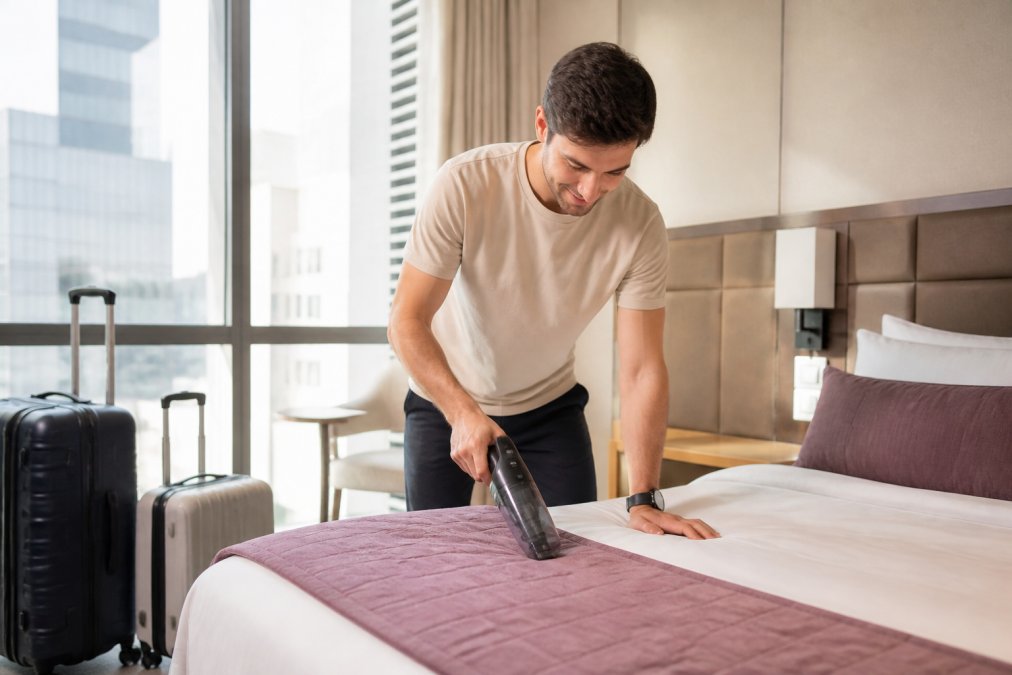
Manufacturer runtime claims deserve skepticism. A vacuum advertised as 60 minutes typically achieves that using the lowest suction setting on a fully charged, brand-new battery in ideal conditions. At realistic power levels for car interiors and hotel floors, expect 30-40% less runtime than advertised.
The sweet spot for travel is 40-50 minutes of actual usable time. This duration handles most hotel rooms, vacation rentals, and vehicle interiors without requiring a mid-cleaning charge.
Lithium-ion vs. Other Battery Types
Lithium-ion batteries dominate portable vacuum design because they offer superior energy density compared to alternatives. They store more power in a smaller, lighter package and maintain consistent voltage throughout the charge cycle, so your vacuum doesn't gradually lose suction as the battery depletes.
Nickel-cadmium and nickel-metal hydride batteries, used in older handheld vacuums, suffered from memory effect and self-discharge. Lead-acid batteries are far too heavy for portable applications. Solid-state batteries promise higher energy density and faster charging but remain expensive and aren't yet standard in consumer portable vacuums.
Quality portable vacuums include battery management systems that prevent overcharging and thermal runaway. When comparing models, verify that the battery includes protection circuitry.
Suction Power vs. Battery Longevity Trade-offs
Stronger suction demands more electrical current from the battery, shortening runtime proportionally. A vacuum with 150 air watts will deplete its battery roughly twice as fast as one with 75 air watts. This creates a fundamental trade-off: maximum cleaning power or maximum runtime.
For travel, moderate suction often proves more practical. A vacuum delivering 100-120 air watts with 45-50 minutes of runtime handles hotel carpets and car interiors efficiently without the weight penalty of a high-power model.
Some portable vacuums offer selectable power modes, eco, standard, and turbo, allowing you to balance suction against battery life on the fly. Use eco mode for light dust and standard mode for typical cleaning; reserve turbo for stubborn debris. This flexibility extends effective runtime by 20-30%.
TSA Regulations for Lithium-ion Batteries in Portable Vacuums
Portable vacuums with lithium-ion batteries are permitted in carry-on and checked luggage according to current regulations. The Transportation Security Administration allows lithium-ion batteries up to 100 watt-hours (Wh) without special approval (tsa.gov). Most handheld vacuums fall well below this threshold, with batteries typically ranging from 27-62 watt-hours.
TSA guidelines on lithium batteries in baggage specify that batteries must be installed in or packaged with the device, not loose in luggage. Keep your vacuum in carry-on luggage rather than checked bags to reduce damage risk and ensure availability during your trip.
Batteries between 100-160 Wh require airline approval and are limited to two per passenger. Batteries exceeding 160 Wh are prohibited entirely. Always check with your specific airline before traveling, as some carriers impose stricter limits than the TSA baseline. International travel requires additional verification, as different countries maintain different regulations.
When packing your vacuum for air travel, ensure the battery is not exposed to extreme temperatures during ground transport. Keep the device in a climate-controlled cabin rather than a hot trunk or frigid cargo hold.
How to Extend Vacuum Battery Life During Travel
Extending battery longevity requires attention to both immediate usage patterns and long-term storage practices. Avoid running the vacuum continuously at maximum suction. Instead, clean in multiple short sessions using standard power mode, then switch to turbo only for stubborn debris.
Charge strategically throughout your trip rather than waiting for the battery to fully deplete. Lithium-ion batteries tolerate frequent partial charges better than deep discharge cycles. If you're staying in a hotel for three nights, charge the vacuum each evening rather than attempting to stretch a single charge across all three days.
Keep the vacuum and battery away from direct heat sources. Store the device in a cool closet or bathroom cabinet when not in use. Cold environments are less problematic than heat; a chilled battery simply delivers reduced runtime temporarily, with no permanent damage.
Maintenance Tips for Long-term Battery Health
Clean the battery contacts regularly using a dry, lint-free cloth. Dust and debris accumulating on charging contacts create resistance, reducing charging efficiency and generating heat. If you notice slower charging or reduced runtime despite a full charge, dirty contacts are often the culprit.
Replace the HEPA filter according to the manufacturer's schedule, typically every 3-6 months. A clogged filter forces the motor to work harder, consuming more battery power and generating excess heat that degrades the battery faster. A clean filter improves runtime by 15-20%.
Avoid leaving the battery fully charged for extended periods when not traveling. If you store your vacuum for a month or longer, charge it to roughly 50% capacity, then store in a cool, dry location. This practice reduces stress on the battery chemistry and preserves capacity over time.
Never attempt to disassemble or repair the battery yourself. Lithium-ion batteries contain flammable electrolyte and can ignite if punctured or exposed to moisture. If the battery fails to hold a charge or swells visibly, replace it with an authorized replacement.
Charging Strategies and Travel-specific Solutions
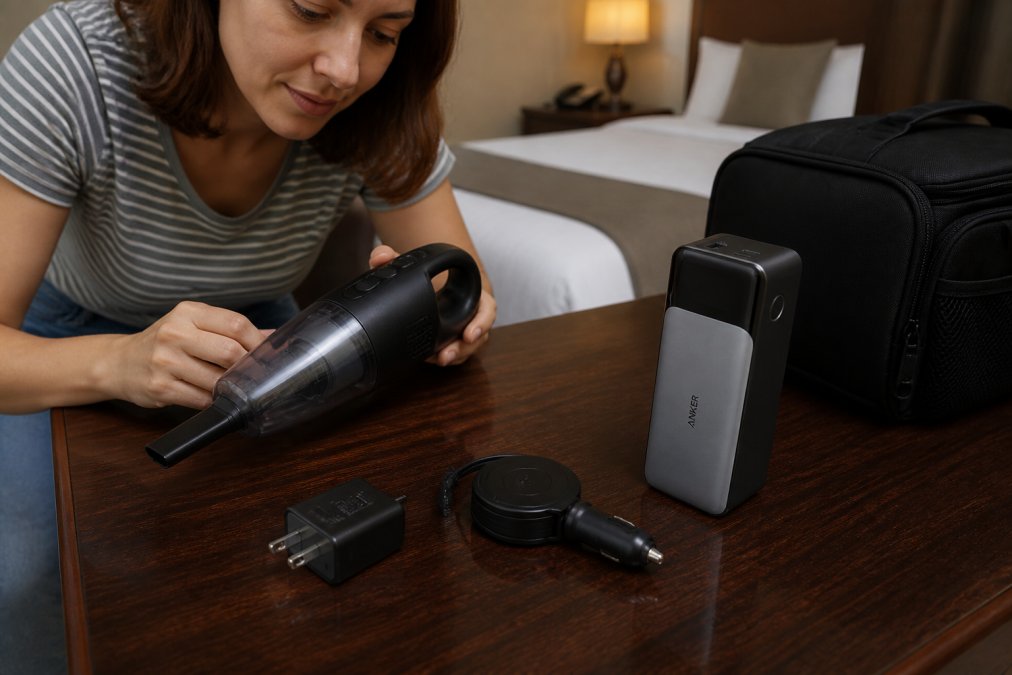
Portable vacuums typically charge via USB-C or proprietary dock connectors. USB-C models offer flexibility; you can charge using any standard USB-C power adapter. The MyStuff Anker 737 Power Bank (PowerCore 24K) provides 24,000mAh capacity with 140W Power Delivery, enabling fast charging for your vacuum and other devices simultaneously.

For car-based travel, a Retractable Car Charger 4-in-1 Fast Car Phone Charger offers convenient charging between destinations. A compact 2-Pack 3-Port USB Wall Charger allows you to charge your vacuum alongside phones and tablets without occupying multiple outlets. For outdoor trips, the MyStuff 10,000mAh Solar Power Bank provides backup charging capability.


Fast-charging capabilities vary by model. Some portable vacuums charge fully in 3-4 hours, while others require 5-6 hours. Check specifications before purchasing if you're planning frequent short trips where rapid turnaround matters.
Portable Vacuum Battery Life for Travel: Real-world Use Cases
A business traveler staying in hotels 2-3 nights per week benefits from a portable vacuum with 45-50 minutes of runtime at standard suction. Charging overnight ensures a fresh battery each morning. This scenario represents the most common travel use case.
Road-trip scenarios differ significantly. A family staying in vacation rentals encounters larger spaces requiring multiple charging cycles. A model with 50-60 minutes of runtime and fast-charging capability (under 4 hours) becomes valuable.
Vehicle maintenance represents another use case. Travelers who detail their cars benefit from portable vacuums with strong suction and moderate runtime. A 30-40 minute runtime suffices for car interiors.
RV travelers may need to clean multiple times daily. A vacuum with 50+ minutes of runtime and the ability to charge via 120V hookups works well. If your RV relies on battery power while dry camping, verify that your vacuum's charging won't strain the RV's electrical system.
Charging Time and Convenience for Frequent Travelers
Charging time directly impacts travel convenience. A vacuum requiring 3-4 hours to charge fully allows overnight charging in most scenarios. Models requiring 5-6 hours create logistical challenges, forcing daytime charging.
Fast-charging technology accelerates the process. Some newer portable vacuums support rapid charging that reaches 80% capacity in 60-90 minutes. However, rapid charging generates more heat, stressing the battery. Use fast-charging strategically rather than as standard practice.
USB-C chargers are nearly universal, so you can borrow chargers from colleagues or use hotel USB outlets without special adapters. Proprietary dock connectors tie you to the manufacturer's charger, adding bulk and creating problems if the charger fails mid-trip.
Battery swappability enhances convenience on extended trips. Some portable vacuums allow you to purchase a second battery, charge one while using the other, and rotate them throughout the day. For most travelers, a single battery with strategic charging suffices.
Battery Degradation Over Time and What to Expect
Lithium-ion batteries degrade with every charge cycle. After 300-500 complete charge cycles, most portable vacuum batteries retain 80-85% of their original capacity, translating to roughly 2-3 years of regular use before noticeable performance decline (peer-reviewed research).
Frequent deep discharges, completely draining the battery before recharging, stress the chemistry more than shallow cycles. Exposure to high temperatures during storage or use degrades capacity faster. Leaving the battery fully charged for months without use also reduces lifespan.
Real-world degradation manifests gradually. After 18 months, your vacuum might run for 42 minutes instead of 50. After 3 years, it might deliver 35-40 minutes. When capacity drops below 60% of the original specification, replacement becomes practical.
Battery replacement costs vary. Some manufacturers sell replacement batteries for $50-150, while others charge significantly more. Factor in potential replacement costs when evaluating a portable vacuum for travel.
Batteries stored in cool environments (50-70°F) with 40-60% charge degrade much more slowly than those stored warm and fully charged. If not traveling for several months, store your vacuum in a cool closet rather than a hot garage.
Selecting the right portable vacuum for travel requires balancing battery runtime, charging speed, and long-term durability. MyStuff's curated collection of smart essentials includes portable cleaning appliances designed specifically for travelers. Look for models featuring lithium-ion batteries with 40-50 minutes of real-world runtime, USB-C fast charging, and lightweight ergonomic design. Pair your vacuum with MyStuff's charging solutions, power banks and multi-port chargers, to ensure you're never without a charged device. Shop Smart Essentials and discover how the right portable vacuum transforms hotel stays, vacation rentals, and road trips into genuinely clean experiences.
Frequently Asked Questions
Which handheld vacuum has the longest battery life?
Battery runtime varies significantly based on motor efficiency, voltage, and power mode settings. Most cordless handheld vacuums deliver 15-40 minutes of runtime at full suction power, though eco or low-power modes can extend this to 60+ minutes. Look for models with lithium-ion batteries rated at higher mAh capacity (typically 2000mAh or above) and voltage ratings of 18V or more. Check manufacturer specifications for runtime under your actual usage conditions, pet hair and carpet cleaning drain batteries faster than bare floor use.
Can I take my portable vacuum on a plane?
TSA regulations permit lithium-ion battery-powered portable vacuums in carry-on luggage, provided the battery capacity does not exceed 100 watt-hours (Wh). Most handheld vacuums fall within this limit. The vacuum itself must pass standard security screening. If your vacuum's battery exceeds 100Wh, you cannot bring it aboard, check your device's documentation for watt-hour rating. Contact your airline ahead of travel to confirm their specific policies.
How long should a cordless vacuum battery last before needing replacement?
Lithium-ion batteries in cordless vacuums typically retain 70-80% of their original capacity after 300-500 full charging cycles, which usually translates to 2-3 years of regular use. Battery degradation accelerates if you consistently charge to 100% or drain completely. Extend battery lifespan by charging to 80% when possible, avoiding extreme temperatures, and storing the vacuum in a cool, dry place. After 3-4 years, you may notice reduced runtime and power, at that point, battery replacement or a new unit becomes practical.
Does suction power affect how fast a portable vacuum battery drains?
Yes, higher suction power consumes significantly more energy. Running at maximum suction can reduce runtime by 40-60% compared to eco mode. Motor efficiency, airflow design, and cyclonic technology all influence how quickly the battery deplete under load. Heavy debris and carpet cleaning demand more power than light, bare-floor use. For extended travel cleaning sessions, plan to use lower power modes on bare floors and reserve maximum suction for carpets and stubborn debris. This strategy helps you complete longer cleaning tasks on a single charge.
This article was written using GrandRanker